

World Mental Health Day is celebrated annually on 10 October, a date established by the World Federation for Mental Health (WHOF). Today, the World Health Organisation also recognises and marks this day. This year's theme is "Making Mental Health and well-being a global priority".
O World Mental Health Report of the WHO, published in June 2022, revealed that even before the pandemic, in 2019, around 1 billion people were struggling with some form of mental disorder.
Acting in Mental Health Physiotherapy
In this World Mental Health Day, the Board of the Order salutes the work developed by Physiotherapists in the area of Mental Health.
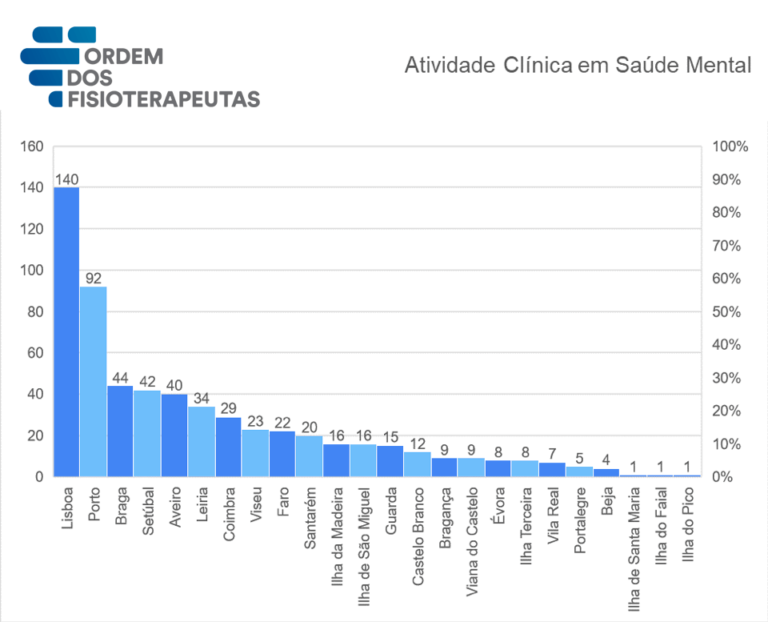
In Portugal, from 8905 Physiotherapists registered in the Order, 693 refer having obtained additional qualifications in Mental Health and 598 refer having clinical activity in Mental Health (graph 1. distribution by districts). There are also 185 physiotherapists with additional qualifications and clinical activity in Mental Health, according to the information extracted from the registration form.
Note: data does not include members who have suspended or cancelled their membership.
Mental Health Physiotherapy is a transversal and specific area of Physiotherapy, which operates in different health, mental health, psychiatric and psychosomatic medicine environments. It aims to optimise wellbeing through health education strategies and the promotion of 1) body awareness, movement and emotions 3) functionality, 4) exercise and physical activity, always integrating the physical and mental and relational dimensions.
Physiotherapy can act on Mental Health, namely on the relationship between somatic disorders and psychological problems (sleep disorders, fear related to pain, psychological stress and depressed mood associated with a clinical condition) in the relationship between mild mental disorders and major chronic non-communicable diseases (anxiety and mild depression associated with cardiovascular and respiratory diseases, diabetes and cancer); in the relationship between somatic disorders and mild mental health disorders (depression associated with chronic pain post-traumatic stress disorder associated with fibromyalgia and anxiety associated with chronic obstructive pulmonary disease) and in the specialised approach to severe mental illness (major depression, schizophrenia, bipolar disorders and addictive behaviours and addictions) in psychiatric units/hospitals.